.webp)

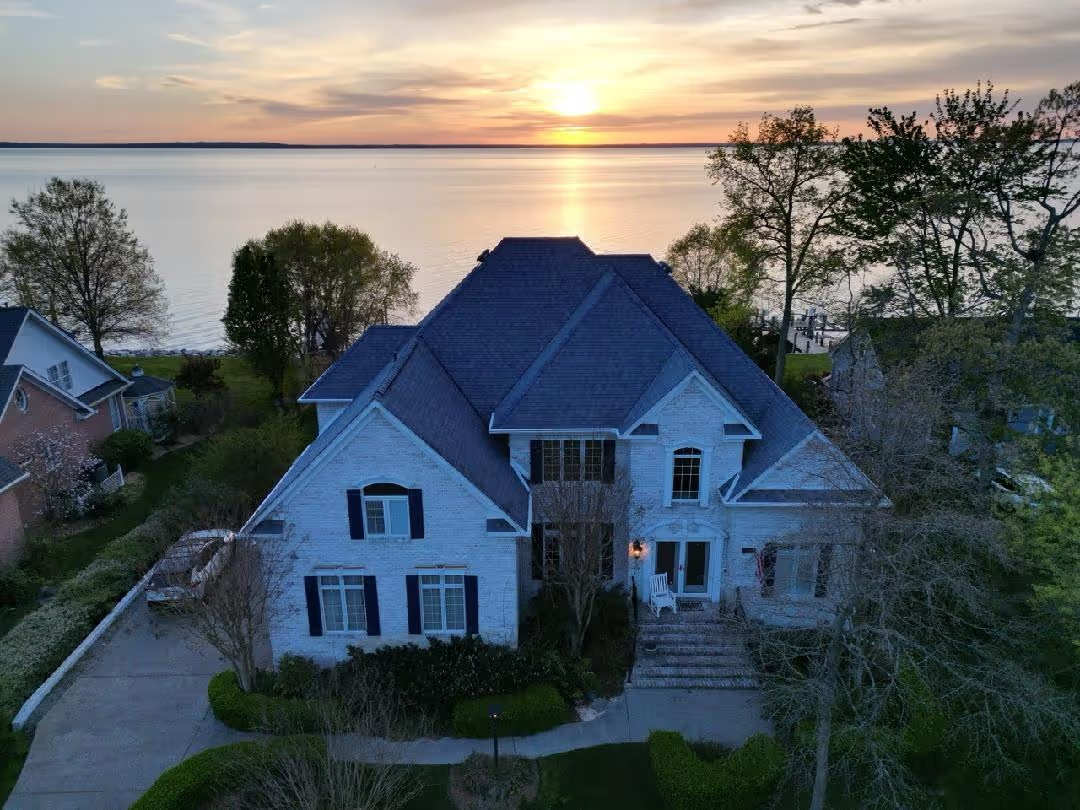
The Roof That Failed
Golden Eagle Roofing's crew arrived at a residential job in Solomons, Maryland expecting a standard 61-square roof replacement. What they found uncovered the reason why it is so important to get a roofing contractor that you can truly trust and someone that doesn't cut corners. The previous contractor had installed the roof without underlayment. No synthetic barrier. No ice and water shield. No secondary moisture protection of any kind. Just asphalt shingles nailed directly to the plywood deck. The homeowner had no way of knowing. That invisibility and corner-cutting is exactly what makes improper installation so costly over time.
What Maryland Code Actually Requires
Maryland adopts the International Residential Code (IRC) and follows the 2021 International Energy Conservation Code (IECC) for residential construction. These are not guidelines. They set the minimum performance standards a roofing system must meet to protect the structure and the people living beneath it.
For any residential roof replacement in the state, current code requires the following components:
Maryland also requires permits and inspections for roof replacements to confirm these components are installed correctly before the job is considered complete. A contractor who skips a permit is also skipping the inspection that would catch exactly the kind of shortcut Golden Eagle Roofing found in Solomons.
The Solomons, MD Case Study
When the crew arrived at the Solomons property, the project scope was clear: a 61-square full replacement. The reality on the deck told a different story.
The prior contractor had removed the old shingles and installed new ones directly on the bare plywood. No felt paper. No synthetic underlayment. No ice and water shield at the eaves or valleys. Nothing between the top layer of shingles and the structural decking beneath them.
This is a direct violation of the International Residential Code and Maryland's current building standards. It also voids the shingle manufacturer's warranty in most cases, because manufacturer installation requirements specify that underlayment must be present for the warranty to apply.
The job required tearing off the improperly installed shingles, inspecting and addressing any deck damage, then properly installing ice and water shield at the eaves and valleys, followed by synthetic underlayment across the full deck surface, before a code-compliant shingle system could go down. The homeowner paid for the same roof twice because a contractor saved a few hundred dollars on materials and labor by skipping a layer.
How Every Missing Layer Raises Your Energy Bills
The connection between a missing roofing layer and a higher utility bill is not obvious from the outside, which is part of why improper installation often goes undiscovered for years. Here is the chain reaction each omission sets off.
Missing Underlayment and Deck Moisture
Underlayment is the secondary defense for the roof deck. When a shingle is cracked by hail, shifted by wind, or simply allows condensation to form on its underside during a Southern Maryland winter, the underlayment stops that moisture from reaching the wood. Without it, the plywood deck absorbs moisture directly.
Wet plywood loses structural integrity over time. More critically for energy performance, it transfers moisture into the attic space. Wet attic insulation loses its R-value, meaning it becomes measurably less effective at resisting heat transfer. When insulation gets saturated, it stops functioning as a thermal barrier. Your home loses heat faster in winter and absorbs heat faster in summer. Your HVAC system runs longer and harder to compensate. Your utility bill reflects that every month.
Missing or Inadequate Ventilation
According to the U.S. Department of Energy's ENERGY STAR program, the combination of proper attic insulation and ventilation is the foundation of a durable, energy-efficient home. In summer, natural airflow through a well-ventilated attic moves superheated air out before it can transfer into the conditioned living space. In winter, a properly cold attic prevents the freeze-thaw cycle that creates ice dams along the eaves.
An under-ventilated attic in Southern Maryland can reach 130 to 160 degrees Fahrenheit on a peak summer day. At those temperatures, heat radiates through the attic floor into the rooms below, forcing air conditioning to compensate constantly. Research from multiple HVAC and roofing industry sources indicates that proper ventilation combined with adequate insulation can reduce annual heating and cooling costs by 10 to 18 percent. Conversely, when ventilation is blocked, missing, or improperly balanced, those savings disappear entirely.
Degraded or Below-Code Insulation
Maryland's R-49 requirement exists because the state's climate demands a meaningful thermal barrier in the attic. When insulation is absent, compressed, or moisture-damaged from a leaking deck assembly, its effective R-value drops significantly below code minimum. The result is a home that requires more energy to heat and cool than it would with a properly installed system, regardless of how efficient the HVAC equipment itself might be.
The ENERGY STAR program notes that adequate insulation, when combined with proper air sealing, can reduce heating and cooling costs by anywhere from 10 to 50 percent depending on the home's starting conditions. That range represents real money, and it is money that improper or incomplete installation leaves on the table permanently until the system is corrected.
The Complete Roofing System: Layer by Layer
A code-compliant roof replacement in Maryland includes all of the following layers, installed in sequence, with each one building on the last:
LayerPrimary FunctionCode ReferenceDrip edge flashingChannels water off edges into guttersIRC R905.2.8.5Ice and water shieldWaterproof membrane at eaves and valleys24-inch minimum inside wall line, Maryland codeSynthetic underlaymentSecondary moisture barrier over full deckIRC R905.1.1, required under all asphalt shinglesStarter stripSeals the shingle course at eaves and rakesPer manufacturer installation requirementsAsphalt shinglesPrimary weather surfaceClass A fire rating required in MarylandRidge capSeals the peak and supports exhaust ventilationPer manufacturer installation requirementsAttic insulationThermal resistance barrier in conditioned envelopeR-49 minimum, 2021 IECC Maryland statewideAttic ventilation systemBalances airflow, controls heat and moisture1/150 net free area ratio, IRC R806
Remove any one of these layers and the system is incomplete. The code violation is the legal problem. The energy penalty is the financial one you live with every day the roof stays that way.
How to Verify Your Contractor Is Installing to Code
Before signing any roofing contract in Maryland, ask the following questions. A qualified, licensed contractor will answer each one without hesitation.
If any of those questions draw hesitation or vague answers, that is useful information. If a contractor tells you that underlayment is optional, that permits slow down the job, or that inspections are not necessary, treat those responses as disqualifying.
For a deeper look at how certification tiers affect the warranties a contractor can offer, see our guide to roofing contractor certifications in Maryland and what they mean for your warranty.
If you are concerned about your roof's ability to handle winter freeze-thaw cycles, the Maryland ice dam prevention and repair guide covers how the interaction between insulation, ventilation, and ice barrier protection works in practice.
What Golden Eagle Roofing Does Differently
Golden Eagle Roofing is a veteran-owned roofing contractor serving St. Mary's County, Charles County, Calvert County, Anne Arundel County, and surrounding Maryland communities. Every full replacement we perform includes a building permit, all required code-compliant layers documented in writing, and a post-installation inspection on record.
We photograph the deck, the underlayment, the ice and water shield placement, and the ventilation configuration before shingles go down. You get documentation of the system that was installed, not just the surface you can see from the driveway.
The Solomons job is a clear example of why documentation matters. The homeowner had no proof of what was or was not underneath the shingles until a new crew got on the roof. A permitted, inspected job removes that uncertainty entirely.
Frequently Asked Questions
Is roof underlayment required by code in Maryland?
Yes. Maryland adopts the International Residential Code, which requires approved underlayment beneath all asphalt shingles. Installing shingles without underlayment is a code violation and voids most manufacturer warranties.
What R-value is required for attic insulation in Maryland?
Maryland requires a minimum of R-49 for attic insulation statewide under the 2021 IECC. This applies across all climate zones in the state and is a meaningful upgrade from older standards that are still common in homes built before the current code was adopted.
Does a roof replacement require a permit in Maryland?
Yes. Maryland requires permits and inspections for roof replacements to confirm the work meets current building code requirements. Contractors who skip the permit are also avoiding the inspection that confirms the system is installed correctly.
How does missing underlayment affect my energy bills?
When underlayment is absent, moisture can penetrate the roof deck and reach the attic insulation. Wet insulation loses its R-value and becomes far less effective at resisting heat transfer. Your HVAC system runs more frequently and for longer cycles to maintain indoor temperature, which raises monthly energy costs in both summer and winter.
What is ice and water shield and why does Maryland require it?
Ice and water shield is a self-adhering waterproof membrane installed at the roof's eaves, valleys, and other vulnerable areas before underlayment and shingles are applied. Maryland requires it to extend at least 24 inches inside the exterior wall line because the state's freeze-thaw climate creates conditions for ice dams every winter. Ice dams form when heat escapes through the roof, melts snow at the ridge, and refreezes at the cold eaves, trapping water beneath the shingles.
Can a roof look new but still have code violations?
Yes. This is exactly what the Solomons, MD case illustrated. The shingles were new and the roof appeared undamaged from the ground. The code violation was only visible once the installation crew was on the deck. Homeowners have no practical way to verify what is underneath the shingles without documentation, a permit record, and a completed inspection on file.
Schedule Your Free Roof Inspection
If your roof was replaced in the last several years without a permit, or if you received a price that seemed lower than comparable quotes, it is worth having the installation verified by a licensed Maryland contractor.
Golden Eagle Roofing offers free roof inspections for homeowners throughout St. Mary's County, Charles County, Calvert County, Anne Arundel County, Montgomery County, and surrounding Maryland communities. We document what we find, photograph every layer we can access, and give you a clear, honest assessment of whether your current roof meets Maryland's building code and manufacturer requirements.
Veteran-owned. Maryland-licensed. No pressure. Contact Golden Eagle Roofing today to schedule your inspection.